Welcome to Decoding Appeals, where Seyfarth’s Appellate Team brings you insights and expertise from the front lines of the courtroom. Throughout this short video series, we break down the nuances of appellate advocacy, sharing tips and lessons we’ve learned to help you navigate the complexities of the appeals process.

In this third episode, host Michael Steinberg sits down with guest Chris Robertson to give viewers an insider’s look at the Supreme Court appeal process. Chris breaks down each step, from filing and opposing cert petitions, to the role of amicus briefs and the rare certiorari before judgment. Viewers also get a behind-the-scenes glimpse of how SCOTUS handles cases compared to other courts, along with what goes into preparing for a Supreme Court appeal. Tune in for practical takeaways on navigating the nation’s highest court.

By Christopher J. DeGroffAndrew L. ScrogginsSamantha BrooksJames P. Nasiri and Ridhima Bhalla

Seyfarth Synopsis: Following a handful of sluggish years in terms of EEOC litigation activity, the Commission returned to form by filing 144 merit lawsuits in Fiscal Year 2023. Given that the EEOC finally secured its Democratic majority and had a notably active FY 2023, many expected the Commission to continue this momentum into FY 2024. However, the exact opposite happened—at the time of publication, the EEOC filed only 96 merit lawsuits. This represents not only a filing decline of about 35% compared to FY 2023, but also one of the lowest numbers of EEOC-initiated merit lawsuits in nearly three decades. While the EEOC had a surprisingly quiet year on the litigation front, a close analysis of its FY 2024 filings can help employers understand the Commission’s priority areas and understand what to expect going forward.

In the years following the start of the COVID-19 pandemic, the EEOC scaled down its litigation efforts by filing far fewer lawsuits than it had in years past. For example, our prior EEOC year-end reports documented 94 merit filings in FY 2020, 111 filings in FY 2021, and 94 filing in FY 2022 (the EEOC’s fiscal year runs from October 1 to September 30).These numbers stood in stark contrast to the EEOC’s litigation activity under the Obama Administration, where the Commission filed as many as 300 merit lawsuits in certain years.

As the EEOC transitioned into FY 2023, the Commission appeared to have the necessary leadership and resources in place to increase its litigation activity to these Obama-era levels. The EEOC’s national leadership structure of five Commissioners no longer had a Republican majority, and the Republican General Counsel had been fired. The EEOC also received a sizable budget increase. This situation predictably led to more litigation activity, as the EEOC filed 144 merit lawsuits in FY 2023, which represented a five-year high for the Commission. In addition, in the final month of FY 2023, the U.S. Senate confirmed President Biden’s appointee for EEOC Commissioner (Kalpana Kotagal), giving Democratic appointees majority control of the Commission for the first time in many years. Then just weeks later the Senate confirmed a new General Counsel (Karla Gilbride) to lead litigation efforts.

With this momentum, many expected the EEOC to continue its trajectory into FY 2024 and further increase its filing activity. But the litigation surge appears to have weakened significantly. The EEOC filed just 96 merit lawsuits in FY 2024—back to pandemic levels and among the very lowest number observed in the past three decades. To put this number in context, last year in FY 2023, the EEOC filed 71 lawsuits in September alone. The bottom line is that the Commission exhibited a staggering drop in litigation activity in FY 2024.

Begging the question: why did the EEOC’s litigation activity take such a dramatic downturn in FY 2024? With a Democratic majority and Democratic General Counsel in place at the EEOC, it does not appear that partisan politics obstructed any of the Commission’s litigation goals. One potential factor could relate to the EEOC’s resources. The Commission requested a budget increase of more than $26 million in FY 2024, but ultimately, Congress only approved the same amount of funding the EEOC received in FY 2023. A 5.2% pay raise for employees combined with increased operational costs at the Commission cut into that amount, and just last month, the EEOC was faced with a potential one-day furlough to address its limited funding. The EEOC was able to avoid this furlough, but budget concerns are surely top-of-mind for EEOC leadership. Added to the mix: this year’s EEOC was saddled with a cumbersome inventory from the previous year’s filing surge, and aging cases from years before that. Ultimately, the EEOC approached FY 2024 with more cases but the same resources.  

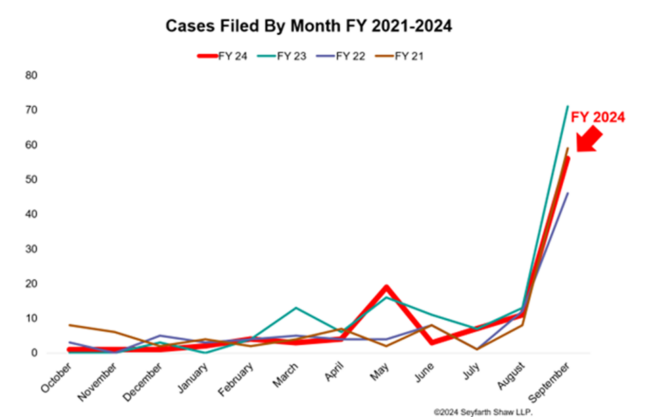
FY 2024 Cases Filed By Month

At the end of every EEOC Fiscal Year, our team at Seyfarth analyzes each EEOC filing in order to identify key trends and provide our one-of-a-kind analysis. Beginning with the timing of the EEOC’s filings, the line graph below displays the number of EEOC lawsuits filed per-month from FY 2021 through FY 2024. As is typical, the EEOC started out FY 2024 at a slow pace, filing only five lawsuits between October 2023 and January 2024. However, unlike prior years, the Commission’s filing activity did not increase as the year progressed. The EEOC filed just three lawsuits in each of March and June, which represents a four-year low in each respective month. The Commission’s litigation activity typically sees a dramatic spike in September, but this FY, the EEOC filed only 56 lawsuits in September (compared to 71 September filings in FY 2023, 46 September filings in FY 2022, and 59 September filings in FY 2021). Additionally, while the Commission did hit a four-year high in terms of its 19 filings in May, almost all of these cases (14 of 19) concerned the enforcement of EEO-1 Report requirements (see below for a more detailed discussion of these cases).

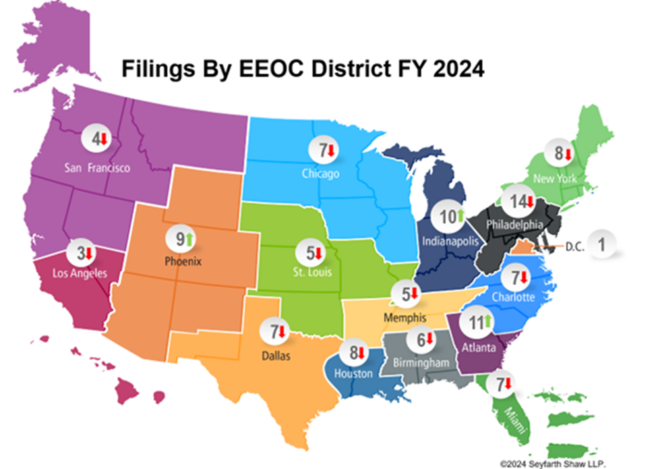
FY 2024 Cases Analyzed By EEOC District Office

With the EEOC experiencing such a significant dip in overall lawsuit filings in FY 2024, the expectation may be that all EEOC District Offices saw a decline in filings as well. Surprisingly, a few EEOC Districts actually increased their number of filings in FY 2024 despite overall EEOC filings decreasing by about 35%. The Indianapolis District Office filed 10 lawsuits in FY 2024 (compared to 9 last year), the Atlanta District Office filed 11 lawsuits this year (compared to 7 last year), and the Phoenix District Office also filed 9 lawsuits this year (compared to 8 last year). Conversely, Districts that have traditionally led the pack in filings—such as Chicago, Los Angeles, and New York—saw extreme declines in filings this year, as these Offices filed only 7, 3, and 8 lawsuits, respectively. The West Coast in particular was notably quiet this year, as the Los Angeles and San Francisco combined for just 7 merit filings in FY 2024. The Philadelphia District Office, which led the way last year, saw the largest decline from 22 filings in FY 2023 to just 14 filings in FY 2024.

Analysis of the Types of Lawsuits Filed in FY 2023

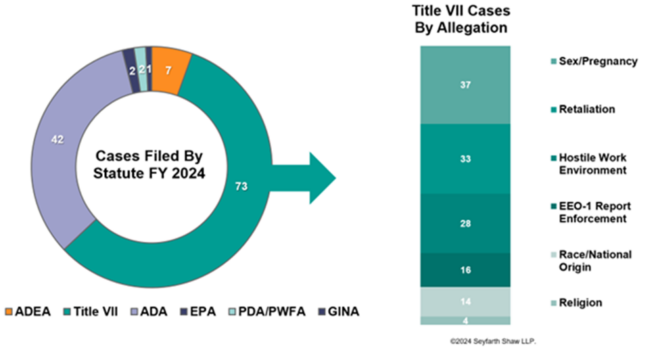
In addition to tracking the timing and location of EEOC lawsuit filings, we also analyze the underlying claims asserted in all EEOC-initiated cases. At a high level, despite the drastic dip in overall filings, the EEOC’s FY 2024 filing numbers generally align with prior years. Once again, the vast majority of its lawsuits were filed under Title VII and the Americans with Disabilities Act (“ADA”). While the Age Discrimination in Employment Act (“ADEA”) is typically the third-most common statute cited in EEOC cases, the Commission lodged only seven ADEA filings in FY 2024.

Equal Pay Act (“EPA”) claims are typically not a common basis for EEOC lawsuits, and that trend continued this year as just two were filed. On the other hand, the Commission opted to file its first case in several years alleging violations of the Genetic Information Nondiscrimination Act (“GINA”), which prohibits discrimination based on genetic information in employment and medical coverage. The EEOC also filed a handful of lawsuits this year alleging pregnancy-based claims. Most notably, the EEOC filed its first three lawsuits under the Pregnant Workers Fairness Act (“PWFA”). The PWFA went into effect June 27, 2023, and on April 15, 2024, the EEOC issued its final regulations concerning enforcement of the Act.

Taking a closer look at these numbers, the ADA remained a focus for the EEOC. The Commission filed 42 disability-related lawsuits in FY 2024, which is nearly 40% more than it filed in FY 2022, despite overall filings in FY 2022 totaling just two fewer than this year. While the EEOC’s filings concerned a broad range of disabilities, the Commission built on a trend from the end of the previous year and continued to prioritize hearing-related disabilities. In January 2023, the EEOC published guidance regarding hearing disabilities in the workplace. Since that point, the Commission has filed a total of 16 ADA cases on behalf of hearing impaired employees (nine in FY 2023 and seven in FY 2024).

Another consistent litigation priority for the EEOC is curbing workplace harassment. To that end, in April 2024, the EEOC released its updated Workplace Guidance to Prevent Harassment. This guidance expanded upon prior EEOC materials by addressing harassment in virtual work environments. Additionally, in June 2024, the Commission released anti-harassment guidance specifically targeting employers in the construction industry. The EEOC’s emphasis on halting workplace harassment was reflected by the Commission filing double-digit hostile work environment lawsuits for at least the third straight year.

The EEOC accused several employers of running afoul of anti-harassment laws in non-office work environments. For example, in FY 2024 the EEOC sued:

  • An Arizona manufacturer of human and pet health supplements alleging sex discrimination, sexual harassment, and retaliation (EEOC v. Good Health Manufacturing, Inc., No. 2:24-cv-1679, D. Ariz.);
  • An Illinois hog farm alleging discrimination and harassment on the basis of an employee’s sex and gender identity (EEOC v. Sis-Bro, Inc., No. 3:24-cv-968, S.D. Ill.);
  • A Massachusetts tire dealer alleging a pattern of discrimination and harassment against Hispanic employees (EEOC v. Bob’s Tire Co., Inc., No. 1:24-cv-10077, D. Mass); and
  • Two car dealers—one in Texas and the other in Indiana—alleging sexual harassment against female employees (EEOC v. NICPA Central Auto Group, LLC & Central Austin Motorcars, No. 1:23-cv-01541, W.D. Tex.; EEOC v. Chesterfield Valley Investors, LLC, No. 1:24-cv-00721, S.D. Ind.).

Another interesting takeaway from the EEOC’s FY 2024 filing numbers is that, for the first time in many years, the EEOC used its litigation capabilities to enforce the submission of EEO-1 Reports. By way of background, the EEOC requests annual workforce data from employers with more than 100 employees, with the most common type of report being an EEO-1 Employer Information Report. As the EEOC notes on its website, “[e]mployers meeting the reporting thresholds have a legal obligation to provide the data; it is not voluntary.” In an effort to enforce this requirement, the EEOC filed a whopping 16 lawsuits alleging Title VII violations against covered employers who failed to file adequate EEO-1 Reports. The Commission posted a press release in May touting these EEO-1 Report filings, and emphasizing that “data collection is an important tool” and that Congress authorized the EEOC not only to collective EEO-1 Report data, but also to enforce data reporting compliance in the courtroom. The vast majority of these cases (14 of the 16) were filed in May, and nearly every EEOC District Office filed a lawsuit concerning EEO-1 Reports. The only District Offices that did not file such a case in FY 2024 were Chicago, Memphis, San Francisco, and Washington, DC (which did not file any lawsuits this year).

As a final point regarding the type of claims asserted by the EEOC in FY 2024, the Commission filed only four religion-based cases. This is particularly interesting because, as we noted in our July 2023 post analyzing EEOC charge numbers, EEOC charges alleging religious discrimination increased nearly seven-fold between FY 2021 (2,111 religion-based charges) and FY 2022 (13,814 religion-based charges). The EEOC filed 11 religious discrimination cases last year, including multiple lawsuits brought on behalf of employees terminated for refusing to comply with vaccine mandates on religious grounds. Despite this massive spike in religious discrimination charges, the EEOC filed only four religion-based lawsuits in FY 2024, with just one of these cases involving COVID-19 vaccination. Given that it has been several years since this batch of EEOC charge filings, it seems that the apparent wave of EEOC religion-based, COVID-19 litigation will be left largely to the private plaintiffs’ bar.

Implications For Employers

While the overall takeaway from the EEOC’s FY 2024 is that the Commission saw a substantial decrease in litigation activity, employers should not drop their guard. One of the EEOC’s two Republican Commissioners (Keith Sonderling) left the EEOC last month, thereby solidifying a Democratic majority for the near future. The Commission also requested a budget increase of over $33 million for FY 2025, which if approved would allow the EEOC to enhance its litigation resources, and likely result in increased case filings. Moreover, the EEOC’s activity in FY 2024 demonstrates that employers—particularly those within the Atlanta and Indianapolis regions—should stay tuned to EEOC trends, with a special emphasis on harassment and disability-related filings. Covered employers should also be sure to submit their EEO-1 Reports in a timely fashion, as the Commission has shown that it will resort to litigation to obtain these reports.

We will continue to monitor these changes closely and keep readers apprised of developments. And, as always, we will keep up-to-date on EEOC data amid the ever-changing political climate and a surprisingly quiet year at the Commission.

For more information on the EEOC or how the Commission’s filing activity may affect your business, contact the authors—Christopher DeGroffAndrew ScrogginsSamantha Brooks, and James Nasiri—or a member of Seyfarth Shaw’s Complex Discrimination Litigation Group.

By Karla Grossenbacher and  Martha Gates

Seyfarth Synopsis: The Equal Employment Opportunity Commission filed a flurry of lawsuits last month alleging violations of federal law concerning pregnancy and related conditions. These cases highlight a new “Bermuda Triangle” of laws that employers must navigate when responding to pregnancy-related requests for accommodation.

The Pregnant Workers Fairness Act added more protections for pregnant workers—employees or applicants who have known limitations related to, affected by, or arising out of pregnancy, childbirth, or related medical conditions—beyond the ones available under existing federal law.

Prior to the PWFA’s passage last year, pregnant workers were protected only by the Pregnancy Discrimination Act, which essentially requires that pregnant workers be treated the same as similarly situated non-pregnant workers, and the Americans with Disabilities Act, which requires employers to accommodate physical and mental conditions that rise to the level of a disability absent undue hardship. Many pregnancy-related conditions, however, don’t constitute disabilities under the ADA.

All three laws now apply whenever an employer is considering a pregnant worker’s accommodation request, and the cases filed by the EEOC in September and October, just months after its final rule issued in June, provide a compliance roadmap for employers reviewing such requests. In short, employers must recognize that pregnancy-related requests for accommodation must be handled differently from others.

Forced leave is an accommodation of last resort. The PWFA, unlike the ADA, expressly includes a provision that prohibits employers from forcing a pregnant worker who is requesting accommodation to take leave when there are other reasonable accommodations available that would allow the employee to keep working.

The EEOC alleged in cases filed against Wabash National Corp. and Urologic Specialists of Oklahoma that the employers forced the pregnant workers to take unpaid leave as an accommodation despite their requests that would allow them to continue working. In the Wabash case, the employee had requested to perform only those duties of her assembler job that didn’t involve bending over for an extended period of time or to be placed on light duty. In the Urologic Specialists case, the employee requested the ability to sit and take breaks.

Employers should engage in the interactive process. Although not alleged as a separate violation of law, the EEOC said in the cases it filed against Wabash and Kurt Bluemel Inc. that the employers didn’t engage in the interactive process with the employee before denying the accommodation. Employers should have meaningful communications with employees requesting accommodations for pregnancy-related conditions or disabilities to properly evaluate the requests, and document these efforts.

Employers need to consider modifying existing policies. The EEOC’s filings are also a warning against rigid policies that don’t account for pregnancy-related needs. In its case against Polaris Industries Inc., for example, the EEOC alleged the company violated the PWFA by failing to accommodate an employee who requested time off for medical appointments and to be relieved of the need to perform mandatory overtime.

Instead of modifying its policies, the company allegedly kept issuing attendance points against the employee when she went to medical appointments and refused to exempt her from mandatory overtime requirements. The EEOC alleged in the Polaris case that its human resources specialist told the employee that “her doctor could give her pregnancy restrictions, but the doctor did not know Defendant’s policies.”

Ability to perform essential functions isn’t required. Unlike the ADA, the PWFA requires accommodation for pregnant workers even if they temporarily can’t perform essential functions of their job. In a number of its recent lawsuits, including the ones against Urologic and Polaris, the EEOC reiterates this rule.

Conduct can give rise to multiple legal violations. Employers must keep top of mind that denying an accommodation request from a pregnant worker can give rise to claims under the related three laws. In its filing against ABC Phones of North Carolina Inc. doing business as Victra, the EEOC alleged that Victra violated both the ADA and the PDA when it withdrew a job offer after a newly hired pregnant worker requested to reschedule a training session so she could go to an urgent ultrasound appointment.

The company allegedly told the employee to reapply when she could “100% attend” any scheduled training. The EEOC said Victra violated the ADA by failing to reschedule the training session to accommodate the pregnant worker and by regarding the pregnant worker as having a disability based on her disclosure of her pregnancy-related complications.

The EEOC also asserted that Victra violated the PDA because Victra had allowed non-pregnant new hires to adjust or reschedule training dates. And in its cases against Polaris and Urologic, the agency asserted a constructive discharge claim under the PWFA against the company because the employee resigned when her accommodations weren’t granted.

Develop separate processes for pregnancy-related accommodations. In the case against Wabash, the EEOC alleged that the company’s use of an existing ADA form in connection with evaluating a pregnant worker’s accommodation request violated the law by making disability-related inquiries that were unnecessary to evaluate her request under the PWFA.

Employers using such forms as part of their process should develop separate forms for use in evaluating accommodation requests from pregnant workers. They must note that use of such forms can’t be mandated, and that requesting documentation to support an accommodation request under the PWFA isn’t allowed in several instances. Employers should also make sure their human resources personnel and management team receive training so they understand the rules handling accommodation requests from pregnant workers.

Astute employers will take notice of the EEOC’s recent filings on accommodations of pregnant workers and learn from them. Compliance with the new trio of laws will only become more important as enforcement continues and caselaw develops in this area.

About the Program: Seyfarth’s Pioneers and Pathfinders virtual roundtable series has tackled critical topics intended to help our clients navigate the implications of generative AI and natural language processing models in the legal industry. Next up in our series—Seyfarth is pleased to bring together an expert panel to address the legal and commercial challenges of disinformation and deepfakes.

Panelists

Catherine Porter, Chief Business Officer, Prove
Hon. Paul W. Grimm (Ret.), David F. Levi Professor of the Practice of Law and Director of the Bolch Judicial Institute at Duke Law School
Puya Partow-Navid, Partner, Seyfarth Shaw LLP
Stephen Poor, Partner and Chair Emeritus, Seyfarth Shaw LLP

Thursday, November 7, 2024
2:30 p.m. to 3:30 p.m. EDT
1:30 p.m. to 2:30 p.m. CDT
12:30 p.m. to 1:30 p.m. MDT
11:30 a.m. to 12:30 p.m. PDT

Cost: There is no cost to attend, however registration is required.

REGISTER HERE

In simple terms, a deepfake is a type of synthetic media where images, videos or audio seem real but have been manipulated or generated with artificial intelligence. While some synthetic or manipulated media have legitimate applications, the ability of deepfakes to exploit and spread disinformation is a quickly growing and significant threat to society—as we have seen from headlines ranging from the U.S. presidential election to Taylor Swift, to deepfake applications for remote jobs, and scams robbing companies of millions of dollars.

Organizations need to be alive to the commercial and legal dangers that deepfakes present and consider the potential safeguards. Indeed, this is a boardroom issue, with misinformation/disinformation ranking as the # most severe near-term global risk, according to the World Economic Forum’s 2024 Global Risks Report. With that in mind, our panel will tackle top-of-mind questions such as:

  • What are the biggest risks of deepfakes that leaders are tackling on behalf of their organizations and their customers/consumers?
  • How are deepfakes impacting the courtroom and evidentiary rules?
  • What legal frameworks exist to address the misuse of deepfakes and offer protections from disinformation?
  • What are some of the technological solutions and best practices that businesses can employ to stay a step ahead of deepfakes and disinformation?
  • How can we educate our employees and stakeholders about deepfakes?

Don’t miss this opportunity to learn from industry leaders and become a pioneer at the forefront of the profession’s evolution—we invite you to register your attendance.

If you have any questions, please contact Sophia Gomez at sgomez@seyfarth.com and reference this event.

Learn more about Pioneers and Pathfinders, a podcast about the people driving change in the legal industry. You can view past Pioneers and Pathfinders virtual roundtable video recordings here: (1) Navigating Risks, Benefits, and Ethical Considerations in the Age of AI; (2) The AI Technology Landscape in Legal: A Strategic Approach from Selection to Implementation; (3) Unlocking AI’s Potential in Lawyer Development; and (4) Board Leadership in the Era of Artificial Intelligence.

To comply with State CLE Requirements, CLE forms requesting credit in IL or CA must be received before the end of the month in which the program took place. Credit will not be issued for forms received after such date. For all other jurisdictions forms must be submitted within 10 business days of the program taking place or we will not be able to process the request.

Our programming is accredited for CLE in CA, IL, and NY. Credit will be applied as requested, but cannot be guaranteed for TX, NJ, GA, NC and WA. The following jurisdictions may accept reciprocal credit with our accredited states, and individuals can use the certificate they receive to gain CLE credit therein: AZ, AR, CT, HI and ME. For all other jurisdictions, a general certificate of attendance and the necessary materials will be issued that can be used for self-application. CLE decisions are made by each local board, and can take up to 12 weeks to process. If you have questions about jurisdictions, please email CLE@seyfarth.com.

Please note that programming under 60 minutes of CLE content is not eligible for credit in GA. programs that are not open to the public are not eligible for credit in NC.

About the Program: With states and local jurisdictions continuously updating employment laws, the landscape of handbook policy requirements is in constant flux. Employers face the ongoing challenge of keeping up with these changes

Seyfarth’s Handbook & Policy Team is at the forefront of addressing these challenges. Join us for this webinar, where we’ll walk you through the most significant changes to handbook policies for 2025, and explore how Seyfarth is assisting employers in crafting and updating employee handbooks and state-specific addenda tailored to each company’s unique needs.

Topics include:

  • The most pressing policy-related updates of which employers need to be aware as we head into 2025.
  • The implications of recent decisions, such as ongoing NLRB opinions, on handbook policies.
  • Policy trend predictions for 2025 and beyond.
  • The significance of a well-crafted employee handbook and the role of state-specific addenda.
  • Best practices for developing and maintaining employee handbooks and policies.
  • How Seyfarth’s Handbook & Policy Team has successfully supported employers in navigating these challenges.

Cost – There is no cost to attend, however, registration is required.

REGISTER HERE

Thursday, October 31, 2024
1:00 p.m. to 2:00 p.m. Eastern
12:00 p.m. to 1:00 p.m. Central
11:00 a.m. to 12:00 p.m. Mountain
10:00 a.m. to 11:00 a.m. Pacific

Speakers

Chelsea D. Mesa, Partner, Seyfarth Shaw LLP
Jean M. Wilson, Senior Counsel, Seyfarth Shaw LLP
Sara Eber Fowler, Partner, Seyfarth Shaw LLP
Renate M. Walker, Partner, Seyfarth Shaw LLP

Learn more about our Handbooks & Policy Development practice.


If you have any questions, please contact Donna Miskiewicz at dmiskiewicz@seyfarth.com and reference this event.

This program is accredited for CLE in CA, IL, and NY. Credit will be applied as requested but cannot be guaranteed for TX, NJ, GA, NC and WA. The following jurisdictions may accept reciprocal credit with our accredited states, and individuals can use the certificate they receive to gain CLE credit therein: AZ, AR, CT, HI and ME. The following jurisdictions do not require CLE, but attendees will receive general certificates of attendance: DC, MA, MD, MI, SD. For all other jurisdictions, a general certificate of attendance and the necessary materials will be issued that can be used for self-application. Please note that attendance must be submitted within 10 business days of the program taking place. CLE decisions are made by each local board and can take up to 12 weeks to process. If you have questions about jurisdictions, please email CLE@seyfarth.com

Please note that programming under 50 minutes of CLE content is not eligible for credit in NJ, and programming under 60 minutes of CLE content is not eligible for credit in GA. Programs that are not open to the public are not eligible for credit in NC.

By Jennifer L. Mora

Seyfarth Synopsis:  On December 23, 2022, President Biden signed the “James M. Inhofe National Defense Authorization Act for Fiscal Year 2023” which, among many other things, amended Section 19 of the Federal Deposit Insurance Act, 12 U.S.C. Section 1829 (FDIA), to reduce hiring barriers across the financial services sector. As a result of this “Fair Hiring in Banking Act,” the category of crimes for which a financial institution can outright reject a job applicant or terminate an employee has been significantly narrowed. More recently, and as expected, the Federal Deposit Insurance Corporation (FDIC) approved a final rule (2024 Final Rule), effective October 1, 2024, to update its Section 19 regulations to conform to the Fair Hiring in Banking Act’s amendments.

Section 19 in a Nutshell

Section 19 prohibits, absent prior written consent of the FDIC, a person convicted of a crime involving dishonesty, breach of trust, or money laundering from (broadly speaking) working for or otherwise participating, directly or indirectly, in the conduct of the affairs of a FDIC-covered financial institution. Section 19’s prohibition also covers anyone who has agreed to enter a pretrial diversion or similar program in connection with the prosecution of a crime involving dishonesty, breach of trust, or money laundering.

To ensure that a financial institution does not violate Section 19, it must engage in a “reasonable” inquiry of a person’s criminal history to determine whether they have a disqualifying offense. The 2024 Final Rule now requires that financial institutions document that inquiry. What that looks like, however, is left to the discretion of the financial institution, although most order a criminal history background check or require the person to submit to a fingerprint check (or both).

The Amendments to Section 19 and the 2024 Final Rule

Here we discuss the 2024 Final Rule as it relates to the recent Amendments to Section 19:

What is a crime of “dishonesty” or “breach of trust”?

The amendment to Section 19 provides guidance to institutions in determining whether an offense is one of “dishonesty” by including a helpful definition of the term. Specifically, a “criminal offense involving dishonesty” means an offense where the person, directly or indirectly, cheats or defrauds, or wrongfully takes property belonging to another in violation of a criminal statute. It also includes an offense that federal, state, or local law defines as “dishonest,” or for which dishonesty is an element of the offense. The term does not, however, include a misdemeanor criminal offense committed more than one year before the date on which a person files a waiver application, excluding any period of incarceration, or an offense involving the possession of controlled substances. According to the 2024 Final Rule, the one-year period runs from the date of the offense, not the date of disposition of the conviction or program entry. If there are multiple offenses, then the one-year period runs from the “last date of any of the underlying offenses.”

Although the amendment to Section 19 does not include a definition of “breach of trust,” the 2024 Final Rule does, stating that the term refers to “a wrongful act, use, misappropriation, or omission with respect to any property or fund that has been committed to a person in a fiduciary or official capacity, or the misuse of one’s official or fiduciary position to engage in a wrong act, use, misappropriation, or omission.”

Which older offenses no longer require an application?

The Section 19 amendment states that unless the conviction or program entry relates to an offense subject to the “minimum 10-year prohibition period” for certain offenses in 12 U.S.C. 1829(a)(2), an applicant or employee no longer needs a waiver application if:

  • it has been seven years or more since the offense occurred (measured from the date of offense, not the date of disposition); or
  • the person was incarcerated, and it has been five years or more since the person was released from incarceration; or
  • the person committed the offense before age 21 and it has been more than 30 months since the sentencing occurred (which means the date the court imposed the sentence).

Did the 2024 Final Rule update the types of offenses that qualify for the de minimis exemption?

On July 24, 2020, the FDIC issued a Final Rule which, among other things, expanded the de minimis exemption in a number of ways (2020 Final Rule):

  • It increased the number of minor de minimis offenses on a criminal record to qualify for the de minimis exception from one to two;
  • It eliminated the five-year waiting period following a first de minimis offense and established a three-year waiting period following a second de minimis offense (or 18 months if the offense occurred when the person was 21 years of age or younger);
  • It increased the threshold for small-dollar, simple theft from $500 to $1,000 (the same dollar threshold for bad or insufficient funds check offenses);
  • It expanded the de minimis exemption for crimes involving the use of fake identification to circumvent age-based restrictions from only alcohol-related crimes to any such crimes related to purchases, activities, or premises entry.

Amended Section 19 permitted the FDIC to engage in rulemaking to expand the types of offenses that qualify as de minimis, and the 2024 Final Rule did so by:

  • Increasing the requirement that the offense be punishable by a term of one year or less (excluding periods of pre-trial detention and restrictions on location during probation and parole) to three years or less.
  • For “bad check criteria,” increasing the aggregate total face value of all insufficient funds checks across all convictions or program entries related to insufficient funds checks from $1,000 or less to $2,000 or less.
  • Excluding a new category of lesser offenses, including the use of a fake identification, shoplifting, trespassing, fare evasion, driving with an expired license or tag, if one year or more has passed since the applicable conviction or program entry.

What has not changed?

Section 19 still requires that there be a conviction of record or a pretrial diversion or similar program. It does not cover arrests or pending cases not brought to trial, unless there is a program entry. Section 19 does not cover acquittals or convictions that have been reversed on appeal, but does cover convictions that are currently being appealed or convictions that have been pardoned. In addition, an application is not required for expunged, dismissed, or sealed records or for youthful offender adjudications. Finally, convictions or program entries for a violation of 12 U.S.C. 1829(a)(2) (which relate to certain federal offenses) can never qualify as de minimis.

Next Steps for Financial Institutions

As the penalties for non-compliance are substantial (including fines of $1,000,000 per day), FDIC-insured institutions should review their policies and practices to ensure consideration of Section 19 when assessing candidates’ conviction and program entry history. Convictions and program entries that are no longer automatically disqualifying under Section 19 should be evaluated under other state and local so-called “fair chance” or “ban the box” laws and ordinances, along with the Equal Employment Opportunity Commission’s “Enforcement Guidance on the Consideration of Arrest and Conviction Records in Employment Decisions under Title VII of the Civil Rights Act.”

By Suzanne L. Saxman and Breanne E. Vaclavik

Seyfarth Synopsis: On October 3, 2024, the Financial Crimes Enforcement Network (FinCEN) issued new guidance concerning the Corporate Transparency Act (CTA) by updating and expanding on the Beneficial Ownership Information (BOI) Reporting Frequently Asked Questions (FAQs) that Seyfarth’s CTA Task Force has covered in the past. Key updates include clarifications on who can access and submit BOI, the use of third-party service providers, exemptions for certain entities, the creation and conversion of reporting companies, and acceptable forms of identification for beneficial owners and company applicants.

Access to BOI and How BOI is Stored

FinCEN may permit access to BOI to federal agencies, state, local, and tribal law enforcement with court authorization, officials at the Department of the Treasury, as well as certain foreign law enforcement authorities under certain conditions. Financial institutions and regulatory agencies that supervise or assess financial institutions may also be permitted to access BOI to comply with customer due diligence requirements under applicable law. Notably, FinCEN clarified that BOI is exempt from disclosure under the Freedom of Information Act (FOIA).

FinCEN emphasized the importance of maintaining the confidentiality and security of BOI, which is stored in a secure, non-public database using information security methods and controls typically used in the Federal government to protect non-classified, yet sensitive information. FinCEN indicated they will continue to work closely with those authorized to access BOI to ensure it is used only for authorized purposes and handled in a way that protects its security and confidentiality.

Submitting BOI and Use of Third-Party Service Providers

The updated FAQs clarified who can assist in BOI submission. Reporting companies can authorize employees, owners, or third-party service providers to file BOI reports on their behalf. When submitting the BOI report, individual filers should be prepared to provide basic contact information about themselves, including their name and email address. Any person filing the report, including a third-party service provider, must certify that the information submitted is true, correct, and complete.

Reporting Company Creation and Conversion

The FAQs clarify that reporting companies are created (or, if a foreign company, registered to do business) in the United States by filing a document with a secretary of state or a “similar office.” A “similar office” includes any office of a governmental authority under the law of a State or Indian Tribe where a domestic entity files a document to be created or a foreign entity files a document to be registered to do business in the United States. Federal agencies are not considered “similar offices.”

Additionally, the FAQs address whether a conversion from one corporate type to another (e.g., LLC to corporation) creates a new domestic reporting company that must file an initial BOI report. Depending on the law of the State or Indian Tribe and the type of entity undergoing conversion, a conversion filing may result in the creation of a new domestic reporting company, which would then be required to file an initial BOI report. Even if a conversion does not create a new domestic reporting company, an updated BOI report may be required if there are changes to previously submitted information, such as a name change or a change in the jurisdiction of formation.

Pooled Investment Vehicle Exemption

The updated FAQs clarify that the exemption for pooled investment vehicles (PIVs) from BOI reporting requirements applies only to PIVs operated or advised by certain entities. Specifically, this includes investment advisers registered with the SEC under the Investment Company Act of 1940 or the Investment Advisers Act of 1940. Exempt reporting advisers (ERAs) not registered with the SEC do not qualify.

However, PIVs are also exempt if operated or advised by a “venture capital fund adviser” that meets specific criteria under the Investment Advisers Act of 1940 and has filed the necessary forms with the SEC. PIVs operated by ERAs that meet these criteria are exempt from BOI reporting, while those relying on other exemptions from SEC registration are not.

Identification and Documentation

 Additionally, the updated FAQs specify acceptable forms of identification for beneficial owners and company applicants, such as non-expired U.S. passport cards and state-issued identification documents. If a beneficial owner’s or company applicant’s identification document does not match their current full legal name due to a recent name change, they should report their current full legal name to FinCEN. They can use an identification document that does not yet reflect the updated name. This also applies when requesting a FinCEN identifier.

If the individual later obtains a new identification document with the updated name, address, or identifying number, they should update their information with FinCEN by filing an updated beneficial ownership information report or updating their FinCEN identifier information, including submitting an image of the new document.

These updates aim to enhance clarity and compliance with the BOI reporting requirements, ensuring that companies understand their obligations and the processes involved,

For more information on BOI reporting obligations under the Corporate Transparency Act, click here.

By Kristina M. Launey

Seyfarth Synopsis: With the Governor’s September 30 deadline to sign bills behind us, we review the employment bills that made the cut to become laws, as well as those that didn’t survive the season. The most notable new laws read intersectionality into FEHA protected categories, recast victims’ time off provisions, adjust paid family leave, and impact protections for freelance workers and whistleblowers.

We previously detailed the cornucopia of key bills California legislators introduced in 2024. Below is our summary of the labor and employment bills the Governor signed into law and key measures that were vetoed. All new laws are effective January 1, 2025, unless otherwise stated.

Soon-to-be-New Laws

SB 1137– Protected Characteristics: Intersectionality

SB 1137 makes California the first jurisdiction to explicitly adopt the concept of intersectionality and clarifies how courts should assess overlapping claims under the state’s anti-discrimination laws. As stated in the law, intersectionality “captures the unique, interlocking forms of discrimination and harassment experienced by individuals in the workplace and throughout society, particularly Black women, as compared to Black men and White women.” Under this new law, the Fair Employment and Housing Act (“FEHA”) will expressly protect the intersection, or any combination of the currently-enumerated protected characteristics from discrimination. 

The bill amends Sections 12920 and 12926 of the Government Code (also amends the Unruh Act and Education Code).

AB 1815 – Race Discrimination – Hairstyles

AB 1815 expands the definition of “race” under the FEHA by removing the term “historically” and including traits associated with race beyond hair texture and protective hairstyles. The new law will also add definitions for “race” and “protective hairstyle” to the Unruh Act.

The bill amends Section 51 of the Civil Code, Section 212.1 of the Education Code, and Section 12926 of the Government Code.

SB 1340 – Discrimination: Local Enforcement

AB 1340 specifies that nothing in the FEHA limits or restricts efforts by any city, county or other political subdivision of the state to enforce local anti-discrimination laws if certain requirements are met. Local laws can be enforced when an employment complaint has been filed with the CRD after the CRD has issued a right to sue notice (but before the expiration of the time to file a civil action in the notice) and the local law at issue is at least as protective as the FEHA. The law requires the CRD to promulgate regulations governing local enforcement pursuant to these provisions.

The bill amends Section 12993 of the Government Code.

AB 2499 – “Victims” Time Off

AB 2499 expands and recasts jury, court, and victim time off provisions as unlawful practices under the FEHA (previously addressed in the Labor Code), placing them under the CRD’s enforcement authority. Specifically, the law prohibits the discrimination/retaliation/discharge of an employee who: takes time off for jury service; takes time off to appear in court as a witness under court order; is a victim and takes time off to obtain relief for their/their child’s health, safety, welfare; and (for employers with 25 or more employees) is a victim/has a family member who takes time off to assist the family member for various reasons related to a qualifying act of violence (instead of crime/crime or abuse). 

Additionally, the new law expands eligibility for reasonable accommodations to include an employee who is a victim/has a family member who is a victim of a qualifying act of violence. Employees will be able to use vacation, personal, and paid sick leave for leaves granted as reasonable accommodations under this provision. Such leave will run concurrently with CFRA/FMLA (if the employee would have been eligible), and be subject to time use limitations. Employers will be required to inform employees of their rights in writing at hire and upon request.

The bill amends Section 214 of the Code of Civil Procedure, Section 48205 of the Education Code; add Section 12945.8 to the Government Code, and amends Section 246.5 of, and repeals Sections 230 and 230.1 of the Labor Code (among other things).

SB 1105 – Paid Sick Leave – Agricultural Employees

SB 1105 expands California’s existing paid sick leave provisions to allow agricultural employees who work outside to use their currently entitled paid sick leave to avoid smoke, heat, or flooding conditions created by a local or state emergency. The law states that its purpose is to confirm that California’s Healthy Workplaces, Healthy Families Act of 2014 (“HWHFA”) provides for the use of paid sick leave under these circumstances under the preexisting “preventive care” reason for use. While this term is not defined in the HWHFA, the Department of Industrial Relations’ FAQs provide that examples of preventive care are annual exams and flu shots. To the extent the legislature intended for “preventive care” to be a more expansive term, SB 1105 provides an important clarification.

This bill amends Section 246.5 of the Labor Code.

SB 1100 – Discrimination: Driver’s License

SB 1100 prohibits statements in employment materials (such as a job advertisement, posting, or application) that an applicant must have a driver’s license. The only exceptions are if the employer reasonably expects the position’s duties to require driving and reasonably believes that an alternative form of transportation would not be comparable in travel time or cost to the employer. Alternative forms of transportation may include a ride hailing service, taxi, carpooling, bicycling, or walking.

The bill amends Section 12940 of the Government Code.

SB 399 – Captive Meetings Ban

SB 399 prohibits an employer from subjecting or threatening discrimination or adverse action against any employee who declines to attend or participate in, receive, or listen to an employer-sponsored meeting or communications regarding the employer’s opinion about religious or political matters. The new law requires employers to continue paying employees who refuse to attend such meetings, and imposes a civil penalty of $500 per employee for each violation. We may well see challenges to this new law, as opponents of the bill were vocal that it is preempted by the NLRA.

The bill adds Chapter 9 (commencing with Section 1137) to Part 3 of Division 2 of the Labor Code.

AB 2123 – Paid Family Leave  

Under AB 2123, employers can no longer require employees to take up to two weeks of earned and unused vacation before the employee’s initial receipt of paid family leave benefits during any 12-month period in which employees are eligible for these benefits.

The bill amends Section 3303.1 of the Unemployment Insurance Code.

AB 1888 – DOJ Labor Trafficking Unit

Governor Newsom approved AB 1888 to establish a Labor Trafficking Unit within the DOJ that will “increase leadership and coordination among state agencies to combat labor trafficking in California.” The Governor signed three other non-employment-related human trafficking bills the same day: AB 2020, SB 963, and SB 1414.

The bill adds and repeals Section 12530.5 to the Government Code.

AB 3234 – Social Compliance Audit

AB 3234 requires an employer that has voluntarily subjected itself to a “social compliance audit” relating to labor laws (regardless of whether the audit is to determine if the employer uses child labor) to post a report detailing the findings of its compliance with child labor laws on its website. The new law defines a “social compliance audit” as a voluntary, nongovernmental inspection or assessment of an employer’s operations or practices to evaluate whether the operations or practices are in compliance with state and federal labor laws, including wage and hour and health and safety regulations, including those regarding child labor.

The bill adds Chapter 1.5 (commencing with Section 1250) to Part 4 of Division 2 of the Labor Code.

AB 2738 – Labor Code Enforcement and OSHA Training

In an effort to address worker injuries and fatalities at concert festivals, this law requires contracts with entertainment events vendors to provide in writing that upon hire for a live event, the vendor will furnish to the contracting entity certain information about the federal and Cal/OSHA trainings its own employees and subcontractors’ employees have completed.

This new law also authorizes public prosecutors enforcing Labor Code violations to recover all remedies available under the Labor Code, which would go first to workers for unpaid wages, damages, or penalties, and the remainder to the General Fund. It also authorizes recovery of fees and costs to the prevailing plaintiff in such an action.

The bill amends Sections 181, 9251, and 9252 of, and adds Section 9252.1 to the Labor Code.

AB 1034– PAGA exemption: Construction Industry Employees

AB 1034 extends the current January 1, 2028 expiration date of the PAGA exemption for employees in the construction industry applicable to work performed under a valid collective bargaining agreement in effect any time before January 1, 2025, to 2038.

The bill amends Section 2699.6 of the Labor Code.

SB 988 – “Freelance Worker Protection Action Act”

SB 988 requires a “hiring party” (not limited to an employer) to pay an Independent Contractor (“IC”) on the date specified by the contract, or if unspecified, no later than 30 days after completion of the freelance worker’s services. This new law prohibits requiring the freelance worker to accept less compensation than what is specified by the contract, to provide more goods or services, or to grant additional intellectual property rights as a condition of timely payment. The hiring party and IC will need to enter into a written contract that the hiring party must retain for no fewer than four years. Hiring parties are also prohibited from discriminating  against an IC for asserting rights under these provisions, and the law creates a private right of action with injunctive relief, damages, fees, and costs available.

The bill adds Part 5 (Section 18100 et seq) to Division 7 of the Business and Professions Code.

AB 224 – Newspaper Distributors and Carriers AB 5 Exemption Extension

AB 224 extends the exemption from the application of Dynamex to newspaper distributors working under contracts with publisher/carriers until January 1, 2030, and extends the corresponding mandatory LWDA payroll and wage reporting requirements.

The bill amends Section 2783 of the Labor Code.

AB 2754 – Port Drayage Motor Carriers Contracts – Liability

AB 2754 extends existing Labor Code provisions to port drayage motor carriers. These provisions prohibit a person or entity from entering into contracts for labor or services with certain types of contractors if they know or should have known that the contract does not include sufficient funds to allow the contractor to comply with all applicable employment laws. The law also imposes joint and several liability for customers of port drayage motor carriers where the motor carriers misclassify drivers as independent contractors.

The bill amends Sections 2810 and 2810.4 of the Labor Code.

AB 2364 – Property Service Worker (Janitorial) Protections

AB 2364 increases the payment provided to qualified organizations that provide mandatory sexual violence and harassment prevention training to janitors. The rates will jump from $65 per participant to $200 per participant for training sessions having fewer than 10 participants, and $80 per participant for training sessions with 10 or more participants, except as specified. These enumerated rate hikes will be in effect until January 1, 2026, and then increase each year thereafter. The new law also requires the DIR to contract with the UCLA Labor Center to study opportunities to improve janitorial industry worker safety and rights.

The bill amends Sections 1420 and 1429.5 of, and adds and repeals Section 1429.6 of, the Labor Code.

Bills Already Signed Into Law

Some laws were ahead of the curve, and were signed into law much earlier in the legislative session.

AB 2299 – Whistleblower Protections Posting

AB 2299, signed into law July 15, 2024, requires the Labor Commissioner to develop, and an employer to post, a model list of employees’ rights and responsibilities under the State’s whistleblower lawsAn employer is considered compliant with the posting requirement set forth in Labor Code section 1102.8 if the employer posts the model list.

The bill amends Section 1102.8 and adds Section 98.11 to the Labor Code.

AB 2288 and SB 92 – PAGA Compromise

We previously detailed the sweeping PAGA reforms effectuated by AB 2288 and SB 92, which were signed into law on June 21, 2024 and are retroactively effective as of June 19, 2024.

The bills amend Sections 2699 and 2699.5 of the Labor Code, and amend, repeals and add Section 2699.3 of the Labor Code.

AB 2049 – Summary Judgment Filing Deadlines

AB 2049, signed into law on July 15, 2024, changes the deadline for a party to file a motion for summary judgment or summary adjudication from the current 75 days to at least 81 days before the hearing on the motion. The deadlines for filing an opposition are likewise extended from 14 days to at least 20 days before the hearing, and for filing a reply from 5 days to at least 11 days before the hearing. The new law prohibits a party from filing more than one motion for summary judgment against an adverse party (multiple motions for summary adjudication are excluded from this prohibition) without leave of court, and expressly prohibits the introduction of new facts in a reply to an opposition to a motion for summary judgment. 

This bill amends Section 437c of the Code of Civil Procedure.

SB 828 – Minimum Wages: Health Care Workers Delay

SB 828 was signed into law on May 31, 2024 and delayed the implementation of SB 525, the health care minimum wage law signed by Governor Newsom on October 13, 2023. This law moved all minimum wage adjustments in SB 525 by one month, which meant that the minimum wage schedule took effect on July 1, 2024 instead of June 1, 2024. Additionally, all future minimum wage increases scheduled to take place after 2024 will take place on July 1, rather than June 1, of each year.

This bill amends Sections 1182.14 and 1182.15 of the Labor Code.

Bills That Did Not Make the Cut

SB 1022 – CRD Group/Class Civil Action Filing Extension: This bill would have made a variety of changes to FEHA administrative timelines, including changes to tolling rules and extending the deadline for the Civil Rights Department (CRD) Director to file a group or class complaint to seven years from the date of the alleged violation. This would have tacked years onto the CRD’s current time limits to bring systemic complaints, and was the very reason why the Governor vetoed the bill.  Despite the veto, the Governor encouraged the Legislature to try again next year with a more reasonable period for CRD to initiate a group or class complaint.

AB 1832 – CRD Human Trafficking Task Force: This bill would have established a Labor Trafficking Task Force within the CRD, “tasked” with taking various actions and working with various state agencies, to combat labor trafficking. Governor Newsom vetoed the bill as redundant of AB 1888.

SB 1116 – Benefits for Striking Workers: Under this bill, after two weeks of an employee’s absence due to a trade dispute or strike, the employee would have been eligible for unemployment benefits under the Unemployment Insurance Code.

AB 2494 – Employer Notification: This bill would have required all employers, public and private, to provide employees with a written notice of coverage under COBRA, in-person and via email, following termination or reduction in hours.

AB 2930 – AI & Automated Decision Systems: This bill would have regulated the use of automated decision tools in employment pay, promotion, hiring, termination, or task allocation for purposes of determining employment terms or conditions. Expect more action on this topic in years to come, as the Governor’s veto message on AB 1047 previewed.

Workplace Solutions

Sign up for our October 2, 2024 webinar regarding these new laws and the new compliance obligations they create for employers. Visit us at Cal Peculiarities for regular updates on the oddities of California employment law, and check out our Policy Matters podcast and newsletter for regular check-ins on California (and national) policy and legislative updates.

Edited by Cathy Feldman and Elizabeth Levy

By Cathy Feldman and Joshua D. Seidman

Seyfarth Synopsis:  Out with the old and in with the new.  Governor Newsom recently signed new laws which extend and clarify employees’ available reasons for use of California paid sick leave.  There are expanded unpaid leave protections for victims of domestic violence, sexual assault, stalking, or qualifying acts of violence, as well as for employees summoned to jury duty or responding to a subpoena or court order to testify under Fair Employment and Housing Act  (FEHA).  The changes go into effect on January 1, 2025.  

As we previously detailed, in 2023, the California legislature significantly expanded the state’s Healthy Workplaces, Healthy Families Act of 2014 (HWHFA), primarily by providing more leave.  This year, Governor Newsom signed bills into law that expand paid sick leave protections. 

Preventative Care for Outdoor Workers

In the last few years, California employment laws have zeroed in on extreme conditions.  For example, Cal/OSHA implemented heat illness standards, and employees cannot be retaliated against for refusing to report to work in emergency conditions.  In this vein, SB 1105  provides that agricultural employees who work outside may use PSL to avoid smoke, heat, or flooding conditions created by a local or state emergency, including when a worksite is closed due to these conditions.  The legislature considered this a clarification of the HWHFA’s provision that PSL can be used for preventive care even though the current FAQs do not contemplate this definition.  We expect California to update its FAQs to address this and the changes addressed in AB 2499 before the end of the year. 

Victim Status Extended And PSL Used As Safe Time 

SB 1105 and AB 2499 collectively brought more expansive changes. Existing law provides for using PSL where there is domestic violence, sexual assault, and stalking; it will now be available to victims of “qualifying acts of violence,” i.e., conduct, or patterns of conduct that justify safe time, including when:

  1. an individual causes bodily injury or death to another individual;
  2. an individual exhibits, draws, brandishes, or uses a firearm, or other dangerous weapon, with respect to another individual; and
  3. an individual uses, or makes a reasonably perceived or actual threat to use, force against another individual to cause physical injury or death. 

PSL Available If A Family Member Is A Victim 

The HWHFA previously limited use of PSL for safe time to when an employee was a victim.  The combination of SB 1105 and AB 2499 extends this category of leave to employees whose family members are victims as well.  (And, as a reminder, as of January 1, 2023 the HWHFA’s definition of “family member” was expanded to include a “designated person” of the employee.)

More Reasons To Use PSL 

Previously, an employee-victim could only use PSL for their own reasons (not to assist a family member) in a handful of specific categories.  AB 2499 extends existing rights to take time to obtain restraining orders, seek medical attention, obtain certain services or counseling and participate in safety planning to family members.  It also creates new explicit rights to take time for relocation, enrolling children in a new school, obtaining legal services, participating in legal proceedings and obtaining childcare in connection with qualifying acts of violence.

The law also allows employees to use paid sick leave for time spent serving on a jury or a victim who takes time off to appear as a witness in court in compliance with a subpoena or court order.

Protecting Leave For Jury Duty, Victims, And Subpoenaed Witnesses Under FEHA

Previously the California Labor Code afforded unpaid leave protections for jury duty, victims serving as witnesses in compliance with a subpoena or court order, and victims of domestic violence, sexual assault, stalking, or crimes.  AB 2499 reformulates these protections under the umbrella of the Fair Employment Housing Act.  This shift gives the Civil Rights Department (“CRD”) enforcement authority over violations of these protections, and eliminates potential Private Attorneys’ General Act claims for such violations.

This move came with additional changes, including limiting the duration of leave employers with at least 25 employees must provide.  First, a victim of a qualifying act of violence may take no more than 12 weeks of unpaid leave.  Second, if an employee’s family member is a victim of a non-fatal crime, and the employee takes leave for the limited purpose of relocating or securing a new residence and enrolling a child in a new school or child care, the employee may take no more than 5 days of leave.  Third, when an employee’s family member is a victim of a non-fatal crime, the employee may take no more than 10 days of leave.

Absences that would also qualify under the Family and Medical Leave Act (FMLA) or CFRA must run concurrently if the employee is eligible. 

AB 2499 also expands eligibility for reasonable accommodations to include employees who are victims, or whose family members are victims of a qualifying act of violence to ensure the safety of the employee while at work. 

Required Notice

Employers must inform employees of their rights under AB 2499 at the time of hire, annually, upon request, and if an employee provides notice that their family member is a victim as defined under the law. 

The CRD will be developing a form that complies with these notice requirements before July 1, 2025—six months after the law goes into effect. 

Workplace Solutions

As AB 2499 and SB 1105 go into effect in less than three months, here are some next steps for employers to consider:

  • Review existing leave policies and practices to ensure compliance with the new laws, including related attendance, conduct, anti-retaliation, and discipline policies and practices.
  • Train supervisory and managerial employees, and HR on the new requirements.
  • Develop a form to comply with the notice requirements to use in advance of the CRD’s development of a form.

Seyfarth is here to help employers with solutions and recommendations to comply with California and nationwide paid leave requirements. Check out the CalPeculiarities Blog for updates on other laws affecting California employers. Edited by Elizabeth Levy

About the Program: With states and local jurisdictions continuously updating employment laws, the landscape of handbook policy requirements is in constant flux. Employers face the ongoing challenge of keeping up with these changes. 

Seyfarth’s Handbook & Policy Team is at the forefront of addressing these challenges. Join us for this webinar, where we’ll walk you through the most significant changes to handbook policies for 2025, and explore how Seyfarth is assisting employers in crafting and updating employee handbooks and state-specific addenda tailored to each company’s unique needs.

Topics include:

  • The most pressing policy-related updates of which employers need to be aware as we head into 2025.
  • The implications of recent decisions, such as ongoing NLRB opinions, on handbook policies.
  • Policy trend predictions for 2025 and beyond.
  • The significance of a well-crafted employee handbook and the role of state-specific addenda.
  • Best practices for developing and maintaining employee handbooks and policies.
  • How Seyfarth’s Handbook & Policy Team has successfully supported employers in navigating these challenges.

Cost – There is no cost to attend, however, registration is required.

REGISTER HERE

Thursday, October 31, 2024
1:00 p.m. to 2:00 p.m. Eastern
12:00 p.m. to 1:00 p.m. Central
11:00 a.m. to 12:00 p.m. Mountain
10:00 a.m. to 11:00 a.m. Pacific


Speakers

Chelsea D. Mesa, Partner, Seyfarth Shaw LLP
Jean M. Wilson, Senior Counsel, Seyfarth Shaw LLP
Sara Eber Fowler, Partner, Seyfarth Shaw LLP
Renate M. Walker, Partner, Seyfarth Shaw LLP

Learn more about our Handbooks & Policy Development practice.


If you have any questions, please contact Donna Miskiewicz at dmiskiewicz@seyfarth.com and reference this event.

This program is accredited for CLE in CA, IL, and NY. Credit will be applied as requested but cannot be guaranteed for TX, NJ, GA, NC and WA. The following jurisdictions may accept reciprocal credit with our accredited states, and individuals can use the certificate they receive to gain CLE credit therein: AZ, AR, CT, HI and ME. The following jurisdictions do not require CLE, but attendees will receive general certificates of attendance: DC, MA, MD, MI, SD. For all other jurisdictions, a general certificate of attendance and the necessary materials will be issued that can be used for self-application. Please note that attendance must be submitted within 10 business days of the program taking place. CLE decisions are made by each local board and can take up to 12 weeks to process. If you have questions about jurisdictions, please email CLE@seyfarth.com

Please note that programming under 50 minutes of CLE content is not eligible for credit in NJ, and programming under 60 minutes of CLE content is not eligible for credit in GA. Programs that are not open to the public are not eligible for credit in NC.